Poets needed software that could keep up with how poems are actually made
Poetry is not just linear drafting. It is arrangement, sound, revision, fragmentation, retrieval, and structural experimentation - and most writing software still treats it like plain prose with line breaks.
A desktop-first poetry environment with mobile continuity
Verso centers around multiple compositional modes, a local SQLite data layer, ProseMirror editing, fragment-canvas interactions, and phonemic analysis built into the writing loop.
The project now spans desktop distribution and mobile continuation through Capacitor, keeping the same poem data and compositional philosophy available across more than one environment.
Core surfaces that define the experience
Drafting
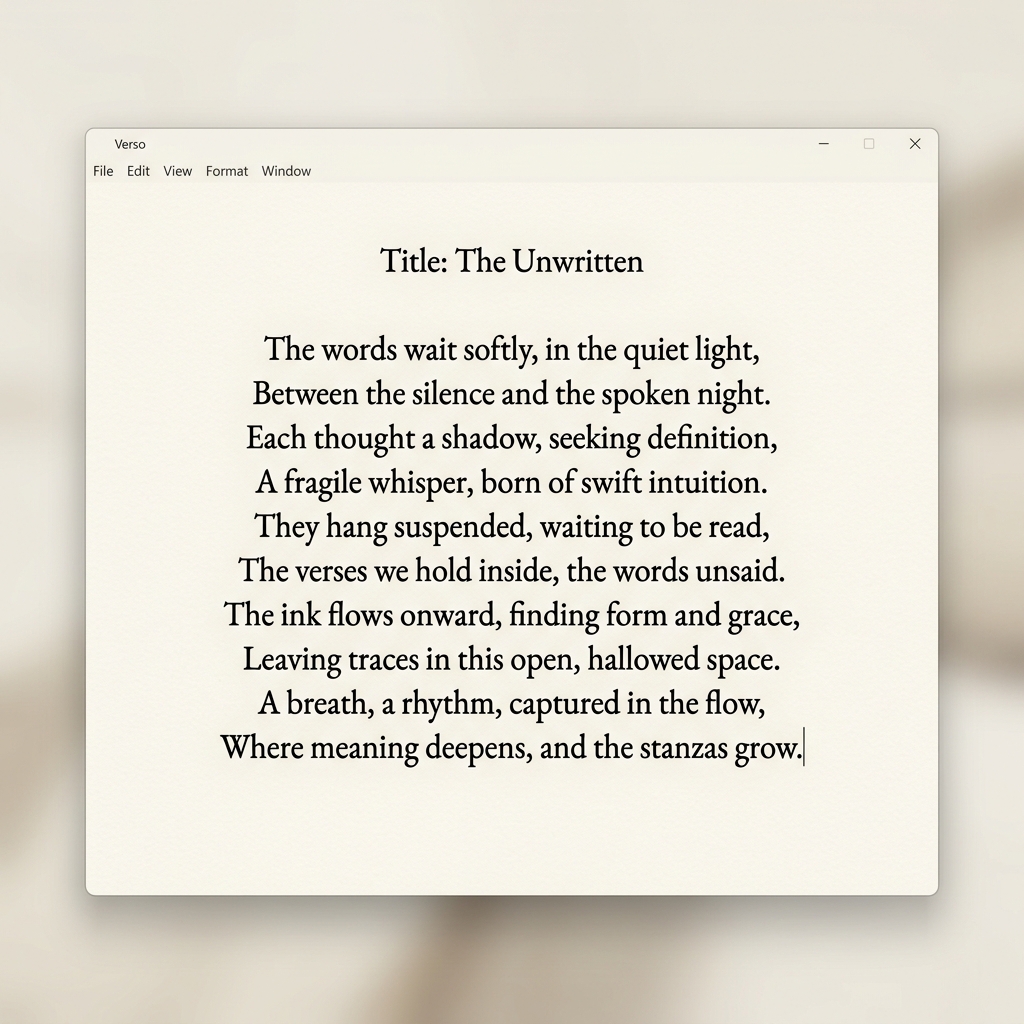
Writers can stay linear when linearity helps
Verso still supports direct drafting and revision, but it treats that mode as one compositional stance among several instead of the whole product.
Conventional writing remains available without defining the system.
Fragmentation
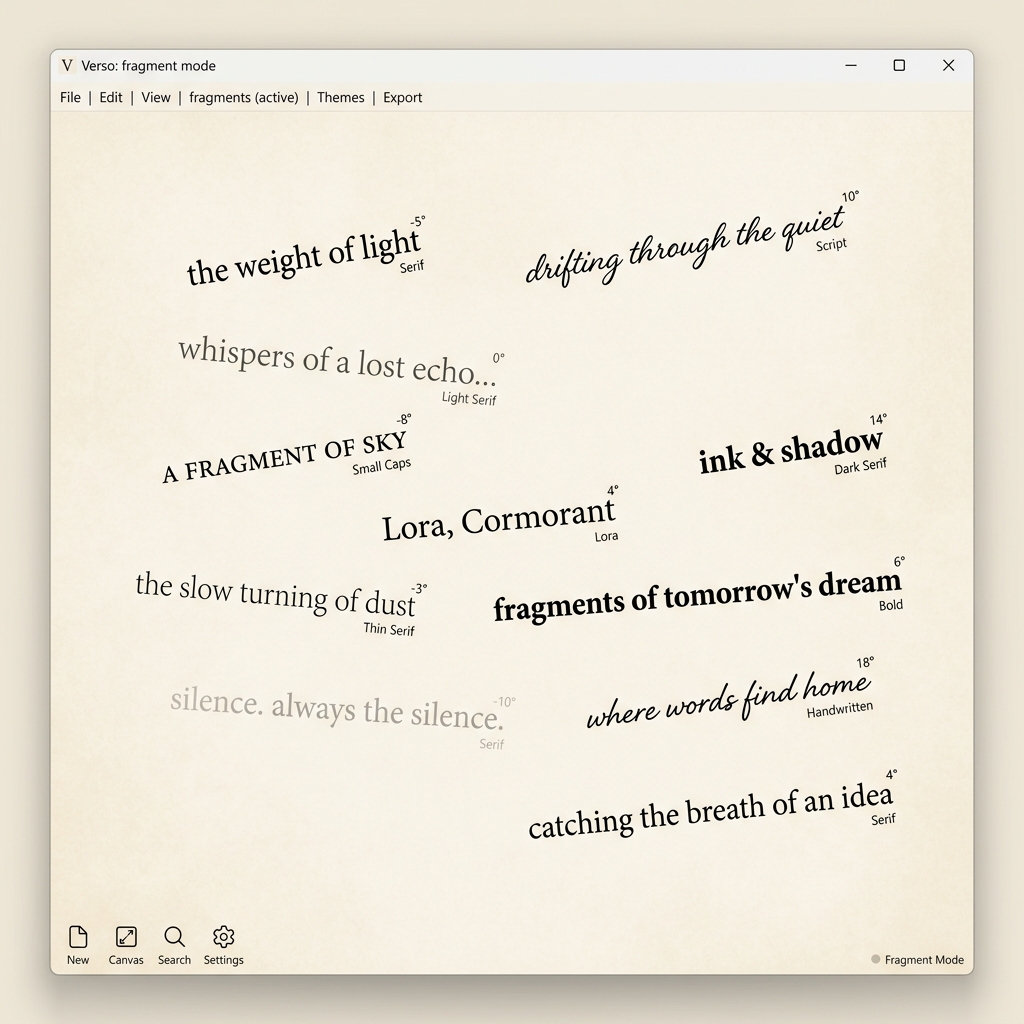
Lines become objects, not just paragraphs
The fragment canvas makes arrangement, distance, collision, and grouping part of the act of writing, giving structure a physical presence.
Composition can happen spatially as well as verbally.
Resonance
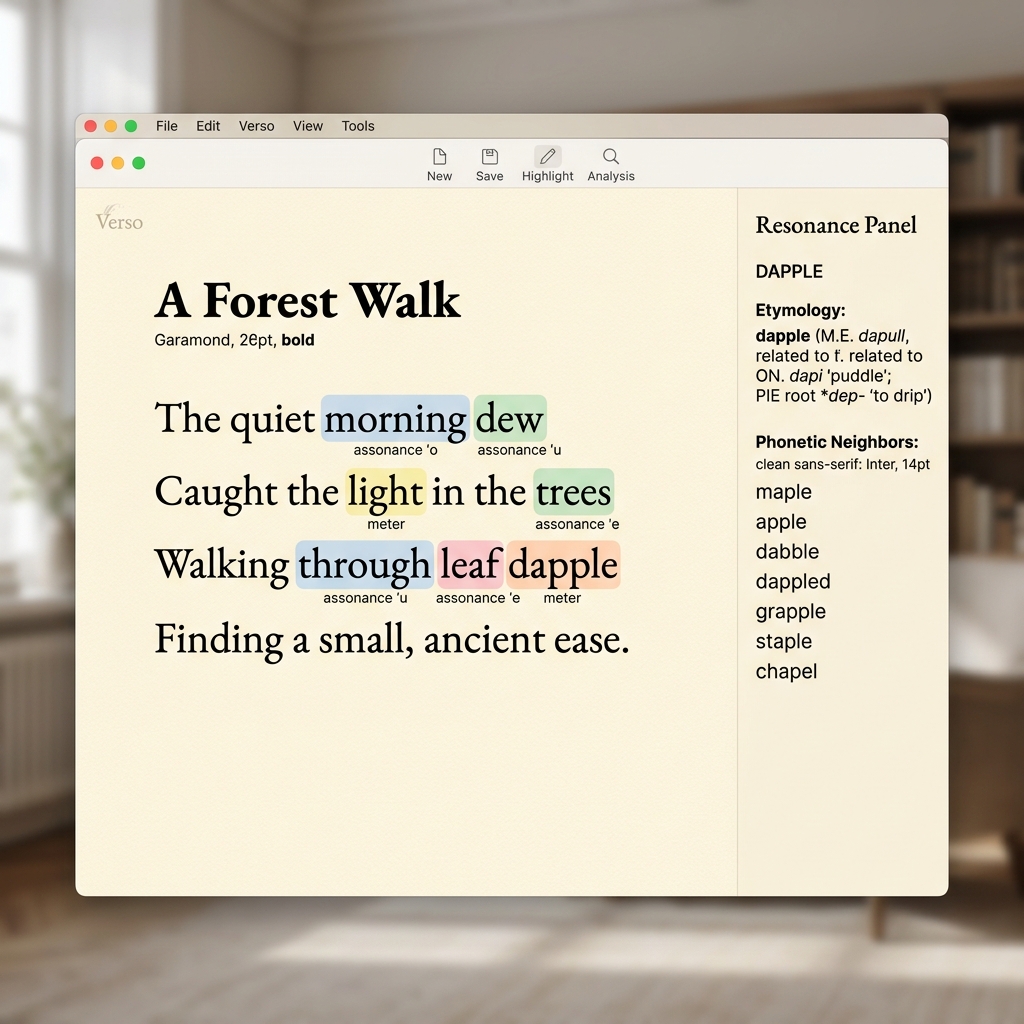
The poem can be revised for sound
Phonemic tooling gives writers another layer of feedback so echoes, stress, and recurrence can guide revision with more precision.
A sonic view of the draft lives inside the editor.
What makes it work
Canvas Physics Engine
Fragment mode turns lines into movable objects with gravity, proximity behavior, and mode-specific interactions that treat composition as a spatial act, not only a textual one.
Phonemic Analysis
Breath and resonance tooling surfaces sound relationships, etymology, stress patterns, and prior appearances so revision can happen at the sonic level as well as the semantic one.
Debasement Tools
Nineteen transformation tools let the writing be split, folded, glitched, blacked out, recombined, and otherwise broken open when straightforward drafting is not enough.
How a poem moves through the system
Verso is strongest when writers can move between drafting, breaking, arranging, and listening without leaving the same creative environment.
01
Draft or gather language
The writing starts in whichever mode best fits the material, from direct prose entry to fragment collection and retrieval.
02
Break open the draft
Transformation tools and the fragment canvas let the poem deform, branch, and rearrange when the original line of thought runs out.
03
Refine through sound and continuity
Resonance tooling and local-first continuity keep revision close to the work, whether the writer is at the desk or carrying the poem elsewhere.